Silence, Haze, and Tonal Depth Across River Valleys and Mountain Ridges
Fog and atmospheric conditions in the Hudson Valley are not simply weather patterns; they are expressive materials. They soften the landscape, quiet the terrain, and create layers that drift into distance with a musical sense of phrasing. For the fine art landscape photographer—especially one working in black and white—these conditions offer a rare opportunity to distill the region into shape, tone, and mood.
This field guide explores how fog, haze, and shifting atmosphere interact with the Hudson River, the Hudson Highlands, the Catskills, and the Shawangunk Ridge.
Why Atmosphere Matters
Atmosphere simplifies. It removes visual noise, softens distant detail, and creates natural separation between foreground, midground, and background. In the Hudson Valley, fog often follows the river’s path, settles into low fields, and wraps around ridge lines. Haze drifts across the Highlands in summer, turning mountains into soft silhouettes. Post‑storm clouds hang low over the Catskills, breaking open to reveal dramatic shafts of light.
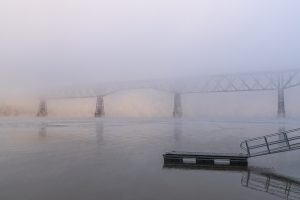
For monochrome work, these conditions are invaluable. They reduce color distraction and emphasize value relationships, allowing compositions to be built around silence, negative space, and long, expressive lines.
Key Atmospheric Scenarios in the Hudson Valley
River Valley Fog at Dawn
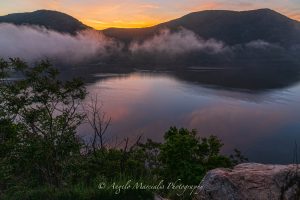
Fog pools along the Hudson River and its tributaries in the early morning, especially during seasonal transitions. From elevated viewpoints—Storm King Mountain, Breakneck Ridge, Bear Mountain, and the Delaware Water Gap—you can look down into fog‑filled valleys and watch ridges emerge like islands.
This is ideal for minimalist river studies, soft tonal gradients, and layered silhouettes. Telephoto lenses compress fog layers beautifully, while wide‑angle lenses capture the full sweep of the valley.
Haze Over the Hudson Highlands
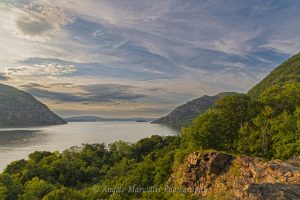
Warm days often produce atmospheric haze rather than dense fog. From Storm King, Breakneck Ridge, and Bear Mountain, the Highlands soften into painterly bands of tone. This is the Hudson River School’s atmosphere—romantic, luminous, and gently diffused.
Haze is perfect for long river curves, distant ridge layering, and quiet, atmospheric studies. In monochrome, subtle dodging and burning can guide the eye through the softened layers.
Fog in Forests and Ravines
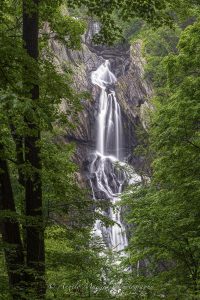
Lower elevations—wooded ravines, waterfall corridors, and forest trails—hold fog longer than open ridges. Approaches to Kaaterskill Falls, Awosting Falls, and the forested paths beneath the Highlands become intimate, enclosed spaces where trunks and branches emerge from soft mist.
These conditions lend themselves to minimalist tree studies, quiet compositions, and intimate landscapes built around shape and repetition.
Post‑Storm Cloud Formations
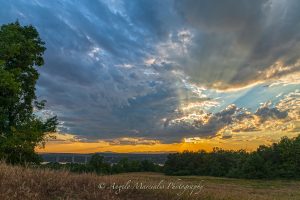
After storms, clouds often cling to the Catskills and Shawangunk Ridge, breaking open to reveal dramatic sky structures. Elevated viewpoints—Sam’s Point, Mohonk ledges, Bear Mountain, and the Catskill escarpment—are ideal for capturing these transitions.
This is the time for sky‑dominant frames, strong diagonals, and dynamic compositions. Higher contrast works well in monochrome, emphasizing cloud structure and light direction.
Seasonal Patterns of Fog and Atmosphere
Spring
Cool nights and warming days create morning fog along rivers and low fields. Budding trees add subtle texture beneath the mist, producing gentle, hopeful scenes.
Summer
Humidity produces haze rather than fog. Ridge lines soften, river bends glow, and late‑day light becomes luminous and diffused.
Autumn
Fog and color coexist. Morning fog partially obscures foliage, revealing bands of color and pockets of clarity. Hillsides become layered tapestries of tone.
Winter
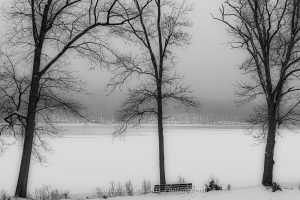
Winter clarity is often high, but certain days bring low clouds and light haze that create minimalist, monochrome scenes. Snow‑covered ridges and frozen river surfaces become strong graphic elements against soft atmosphere.
Compositional Strategies for Atmospheric Work
Layering Ridges and Valleys
Fog and haze naturally separate ridges into tonal bands. From elevated overlooks, these layers become the structure of the composition—each ridge a phrase in a longer visual line.
Negative Space and Silence
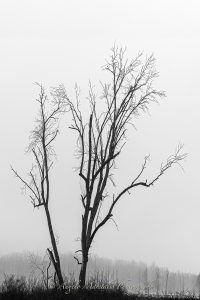
Dense fog creates large areas of negative space. These spaces become emotional centers, suggesting quiet, distance, and introspection. A single ridge, tree, or river curve can anchor the frame.
Curves and Atmospheric Depth
River bends gain added depth when partially obscured by fog. The viewer follows the visible portion and imagines the rest, creating a sense of continuation beyond the frame.
Sky‑Dominant Frames
Post‑storm clouds invite compositions where the sky carries most of the visual weight. Land becomes a quiet counterpoint, grounding the image.
Technical Considerations
• Fog often causes underexposure; slight overexposure preserves midtones.
• For color work, cooler balances suit fog; warmer tones suit haze.
• Wide‑angle lenses capture expansive atmosphere; telephoto lenses isolate layers.
• Tripods are essential for dawn, dusk, and post‑storm conditions.
• Polarizers should be used sparingly—too much clarity removes the mystery.
Black & White Strategies
Fog and haze are inherently monochrome‑friendly. They reduce color complexity and emphasize value relationships.
• Use gentle contrast curves to preserve subtle gradients.
• Apply local contrast adjustments to guide the eye through layers.
• Embrace minimalism—let fog occupy much of the frame.
• Winter haze, autumn fog, and spring mist all translate beautifully into tonal studies.
Explore my Photographer’s Guide to the Hudson Valley for a complete overview of locations, seasons, and techniques.
For elevated vantage points where fog reveals layered vistas, see Top Scenic Overlooks for Landscape Photography in the Hudson Valley.
Click here to discover the atmospheric conditions behind these Hudson Valley landscapes.