Sometimes a photograph reveals its possibilities immediately. Other times, it waits.
That was certainly the case with “Wildflower Morning Waltz,” an image I created on the morning of August 10 while photographing the pastoral landscape surrounding Brookview Farm in Chester, New York.
I had spent the morning composing images of the barn, silos, and surrounding farmland, including the photographs that eventually became my panoramic image “Bucolic Farmlands in D.” That finished panorama was created by stitching together three separate photographs to capture the breadth and quiet atmosphere of the landscape at dawn. But this particular morning offered something else.
While walking back and forth along Route 17M in Chester, I noticed a small cluster of wildflowers bordering the landscape. I composed several photographs, although at the time I wasn’t particularly taken with the overall composition. I honestly didn’t expect to revisit the image. Then Adobe Camera Raw changed my mind.
Discovering the Photograph in Post-Processing
Recently, I have become somewhat “obsessed” with exploring the masking capabilities in Adobe Camera Raw. Those tools encouraged me to return to images that I might otherwise have passed over and to reconsider how the relationship between subject and environment could be shaped during post-processing. When I returned to this photograph, I knew almost immediately what I wanted to accomplish. I would treat the photograph as two distinct elements: the background and the wildflowers themselves.
My objective was not simply to make the flowers stand out. I wanted to create a visual separation between subject and landscape while maintaining the quiet, atmospheric character of the original scene.
Softening the Background
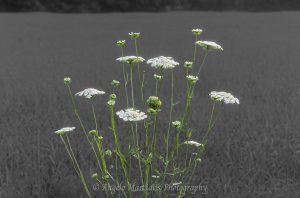
I began with the background. Using a mask in Adobe Camera Raw, I moved the saturation, texture, clarity, and sharpness considerably to the left. Removing the color transformed the surrounding landscape into a soft, monochromatic backdrop.
Because I had already photographed the scene using a shallow depth of field, the original file contained much of the visual softness I wanted. The additional adjustments simply carried that quality further. The result was a subdued, almost impressionistic environment surrounding the flowers.
Rather than competing with the subject, the landscape became atmosphere.
Bringing the Wildflowers Forward
Next, I created another mask specifically for the wildflowers. Here, the adjustments were deliberately restrained.
I altered the color temperature slightly and added what I like to call a gentle “kiss” of saturation. I then increased the texture just a smudge and applied a modest amount of sharpening. These small adjustments gave the flowers greater presence without making them feel disconnected from their surroundings.
The contrast between the softly rendered monochromatic landscape and the delicate color of the wildflowers became the defining characteristic of “Wildflower Morning Waltz.”
Finishing the Photograph in Photoshop
Once I was satisfied with the initial processing, I brought the photograph into Photoshop and continued through my usual post-processing workflow.
And then I did something equally important. I walked away.
I have learned that stepping away from a photograph before declaring it finished can be remarkably valuable. Returning later with fresh eyes often reveals artifacts, distractions, or small compositional elements that escaped my attention during the original editing session. This photograph was no exception.
When I returned, I found several minor distractions that needed cleaning up. Once those were addressed, I saved the image.
Finished. Or so I thought.
When a Color Photograph Asks to Become Black and White
After returning to the photograph a second, third, and perhaps fourth time, I began hearing that familiar, insistent voice suggesting that there might be another interpretation hidden inside the file.
What would happen if I converted it to black and white?
Eventually, if only to quiet that voice in my head, I gave in.
I began working through the different black-and-white filter interpretations available in Photoshop, looking for the treatment that would give the photograph the tonal character I envisioned.
Eventually, I settled on the High Contrast Blue Filter. That was the moment the photograph changed.
The conversion gave the flower stems a deep, textured blackness while simultaneously emphasizing the brightness and delicacy of the florets. Elements that had been defined primarily through color in the first interpretation were now separated through tone, texture, luminosity, and contrast.
The photograph had developed an entirely different voice.
From Wildflower Morning Waltz to Wildflower Transposition
My final adjustments were subtle.
I added a little more contrast and introduced a slight warm toning across the image, giving the finished photograph a restrained sepia character.
And with that, “Wildflower Morning Waltz” became “Wildflower Transposition.”
The title felt particularly appropriate.
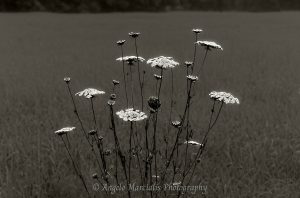
In music, transposition moves an idea into a different tonal center while retaining its essential musical identity. This photograph had undergone something similar. The flowers, composition, and moment remained unchanged, but their visual language had shifted.
Color became tone.
Soft greens gave way to muted grays.
Dark stems became stronger graphic elements.
And the wildflowers acquired an entirely different presence within the landscape.
For me, this is one of the wonderful aspects of fine art landscape photography. The creation of a photograph does not necessarily end when the shutter closes. Sometimes the original exposure is simply the beginning of a conversation between what I saw in the landscape and what I later discover within the image.
Revisiting Our Photographs With Fresh Eyes
There is another lesson here that I find equally valuable. Not every photograph announces itself immediately.
An image that initially seems unsuccessful may contain the beginnings of something much more interesting. A different crop, a change in tonal relationships, selective masking, or a conversion from color to black and white can reveal possibilities that weren’t apparent when the photograph was first created.
That doesn’t mean every overlooked photograph deserves to be rescued. But it does mean that occasionally returning to older files with new techniques and, more importantly, new eyes, can be creatively rewarding.
For “Wildflower Transposition,” the transformation from a selectively colored photograph into a warm-toned black-and-white interpretation allowed me to discover something within the composition that I hadn’t recognized on that August morning in Chester.
Not bad for an image I originally thought I would never revisit. And certainly an enjoyable and productive way to spend a rainy Saturday morning.